

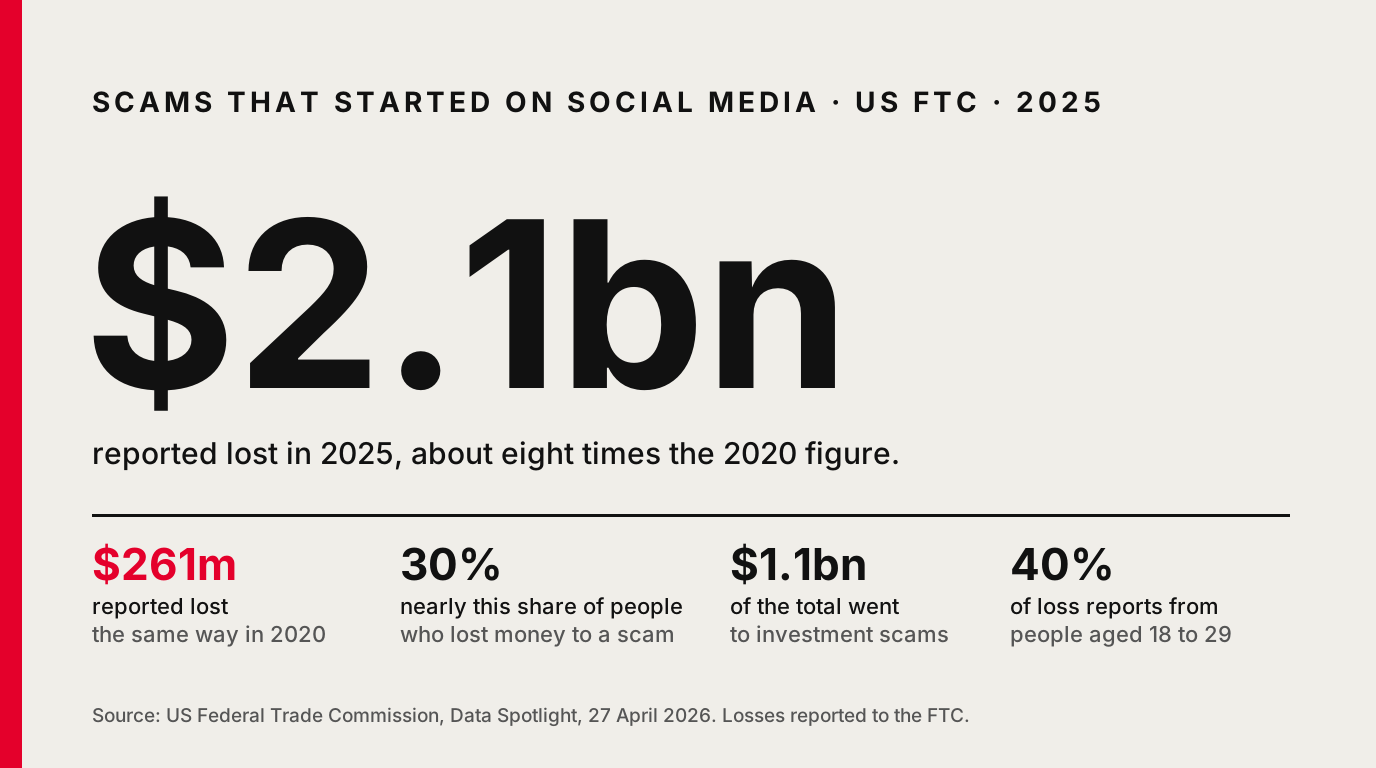
People in the US told the Federal Trade Commission (FTC) they lost $2.1 billion in 2025 to scams that started on social media. In 2020 the figure was $261 million, so it is about eight times higher. The numbers come from reports to the FTC's Consumer Sentinel Network and were published in a Data Spotlight on 27 April 2026.
Nearly 30% of people who reported losing money to a scam in 2025 said it started on social media. Of the $2.1 billion, $1.1 billion, more than half, went to investment scammers. Shopping scams were the type reported most often: more than 40% of people who lost money to a scam on social media said it started when they ordered something they had seen in an ad. Nearly 60% of people who lost money to a romance scam said it started on a social media platform.
More money was reported lost to scams that started on Facebook than on any other platform. WhatsApp and Instagram were "a distant second and third". Among people aged 18 to 29 who reported a loss, 40% said the scam started on social media. For people 80 and over it ranked second, after phone calls.
The FTC says most scams are never reported to the government, so the real losses are likely much higher.
- Never let someone you met on social media direct your investment decisions.
- Before you buy something from an ad, search the company's name with the words "scam" or "complaint".
- Limit who can see your posts and your contacts in your privacy settings.
- In the US, report a scam to the FTC at ReportFraud.ftc.gov.
Source: Federal Trade Commission, Data Spotlight "Reported losses to scams on social media eight times higher than in 2020", 27 April 2026
Read the original: ftc.gov