
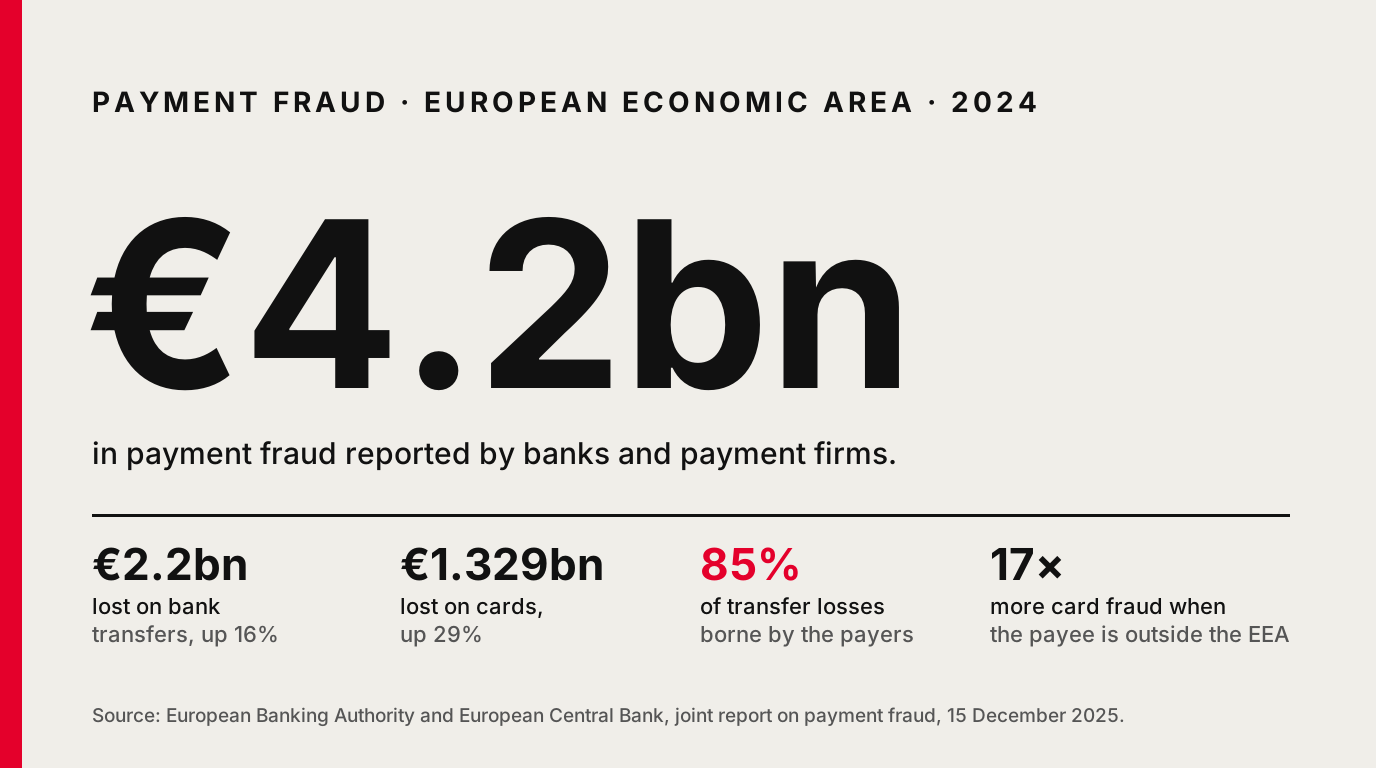
Banks and payment firms in the European Economic Area (the EU plus Iceland, Liechtenstein and Norway) reported €4.2 billion of payment fraud in 2024. That is up from €3.5 billion in 2023 and €3.4 billion in 2022. The figures come from the latest joint report on payment fraud by the European Banking Authority (EBA) and the European Central Bank (ECB), published on 15 December 2025.
Fraud on credit transfers, the payments you send from your own account, cost €2.2 billion in 2024, 16% more than a year earlier. Fraud on cards issued in the EU and EEA cost €1.329 billion, up 29%.
For credit transfers, the people and businesses who made the payments bore about 85% of the losses in 2024, the EBA says. The main reason was scams that tricked them into making the transfers themselves. Card fraud was 17 times higher when the payee was outside the EEA, where strong customer authentication is not required by law. That is the extra check, such as a one-time code or an app confirmation, that banks must ask for before many payments.
Strong customer authentication has been required since 2020, and the EBA says it has helped cut fraud. The report also finds that fraudsters now manipulate account holders into approving fraudulent payments themselves.
- If a caller tells you to approve a payment or move money in your banking app, hang up. When a scam gets you to send the money yourself, you are likely to carry the loss. Customers bore about 85% of transfer fraud losses.
- Only approve a code or app request for a payment you started yourself.
- Be careful paying a shop or seller based outside Europe with your card.
- If you have sent a transfer to a scammer, call your bank straight away on the number on your card.
Source: European Banking Authority and European Central Bank, joint report on payment fraud, press release, 15 December 2025
Read the original: eba.europa.eu