

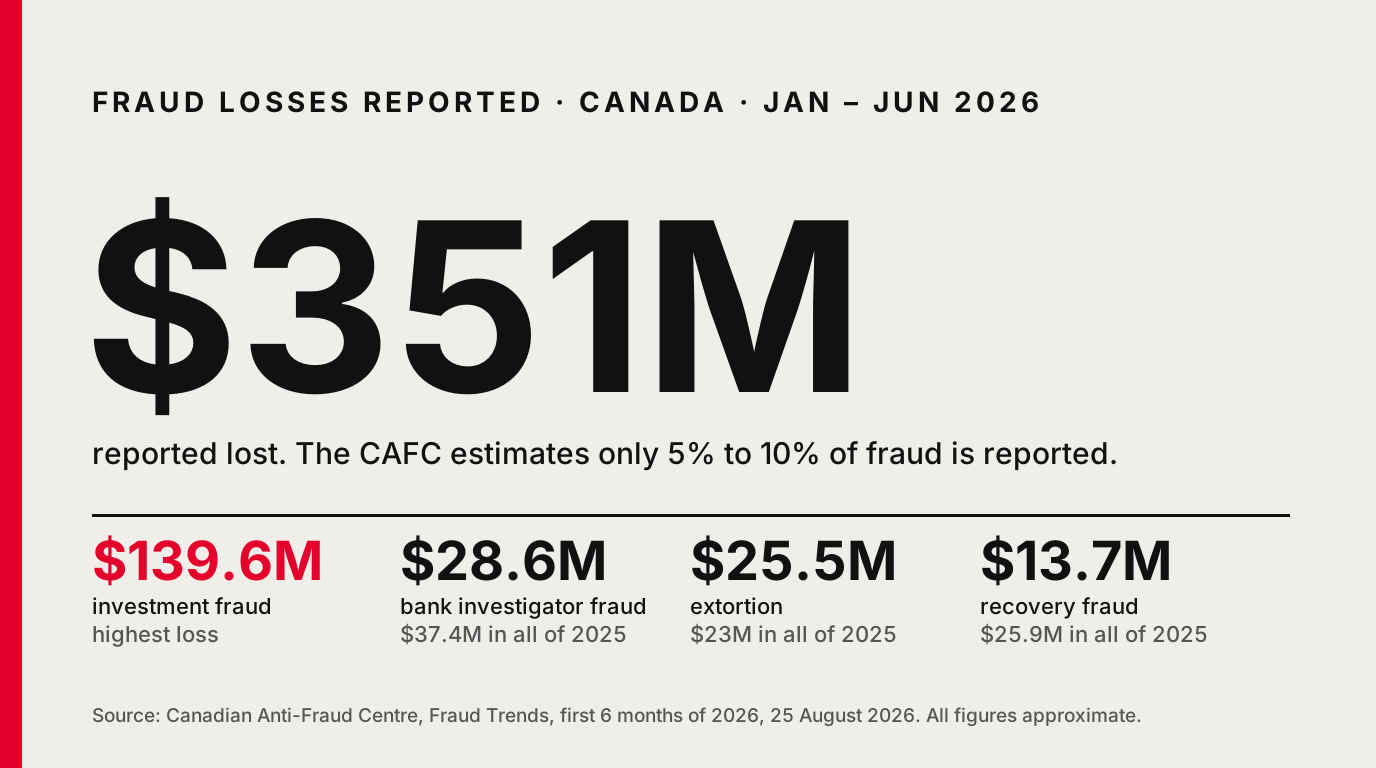
In the first six months of 2026 Canadians reported about $351 million in fraud losses to the Canadian Anti-Fraud Centre (CAFC). The CAFC published the figure on 25 August 2026. It estimates that only 5% to 10% of fraud is reported, so the real losses are likely much higher.
Investment fraud cost the most, about $139.6 million. These offers come through social media, online ads, messaging apps or impersonation, including cryptocurrency schemes, and victims may see fake balances or returns that push them to deposit more.
Four other types stand out against 2025. Spear phishing, where fraudsters pose as a boss, supplier or contractor to redirect a payment, took about $57.7 million, against more than $68 million in all of 2025. Bank investigator fraud, a call claiming your account is compromised, took about $28.6 million, compared with about $37.4 million in all of 2025. Extortion reached about $25.5 million, already above the roughly $23 million reported for all of last year. Recovery fraud, aimed at people who have already lost money, took about $13.7 million, after about $25.9 million in 2025.
In recovery fraud the caller may claim to be from the police, a government agency, a bank or a recovery firm, and asks for fees, taxes or deposits. The CAFC says fraudsters have also used its own name.
- Never move money to a "safe account" because an unexpected caller tells you to.
- Call your bank, a company or a government agency on a number you looked up yourself.
- Never pay anyone upfront to get back money you lost to fraud.
- If you have been targeted, contact your bank at once, then report it to your local police and to the CAFC.
Source: Canadian Anti-Fraud Centre, 25 August 2026
Read the original: antifraudcentre.ca